Abstract
Early childhood is a critical period for physical, cognitive, social, and emotional development. A substantial body of research indicates that motor competence and high-quality physical education are associated with healthier activity patterns, stronger executive functioning, more positive self-perceptions, and broader developmental benefits. This article examines the educational importance of physical education and motor development in childhood and considers the responsibilities of teachers, parents, coaches, and other adults who work with children. It also discusses the relevance of the forthcoming Hargrave Military Academy-hosted Motor Skill Learning Academy Switzerland programme as a practical context for professional learning. Publicly available information indicates that Motor Skill Learning Academy Switzerland provides physical education curricula and coach-certification courses focused on children aged 3 to 7, with an emphasis on engaging instruction and motor-skill development. Hargrave Military Academy is located at 200 Military Drive, Chatham, VA 24531. The central argument of this article is that movement is not peripheral to education; rather, it is one of its foundations, and adults who are properly prepared to teach through movement contribute significantly to children’s health, confidence, participation, and readiness for learning.
Introduction
Physical education in early childhood should not be treated as an optional enrichment activity. From a developmental and pedagogical perspective, it is a foundational area of learning through which children acquire bodily control, movement confidence, participation skills, and habits associated with lifelong health. Research increasingly supports the view that motor competence is linked not only to physical functioning but also to executive functioning, self-perception, and educational participation (Bao et al., 2024; Lorås, 2020).
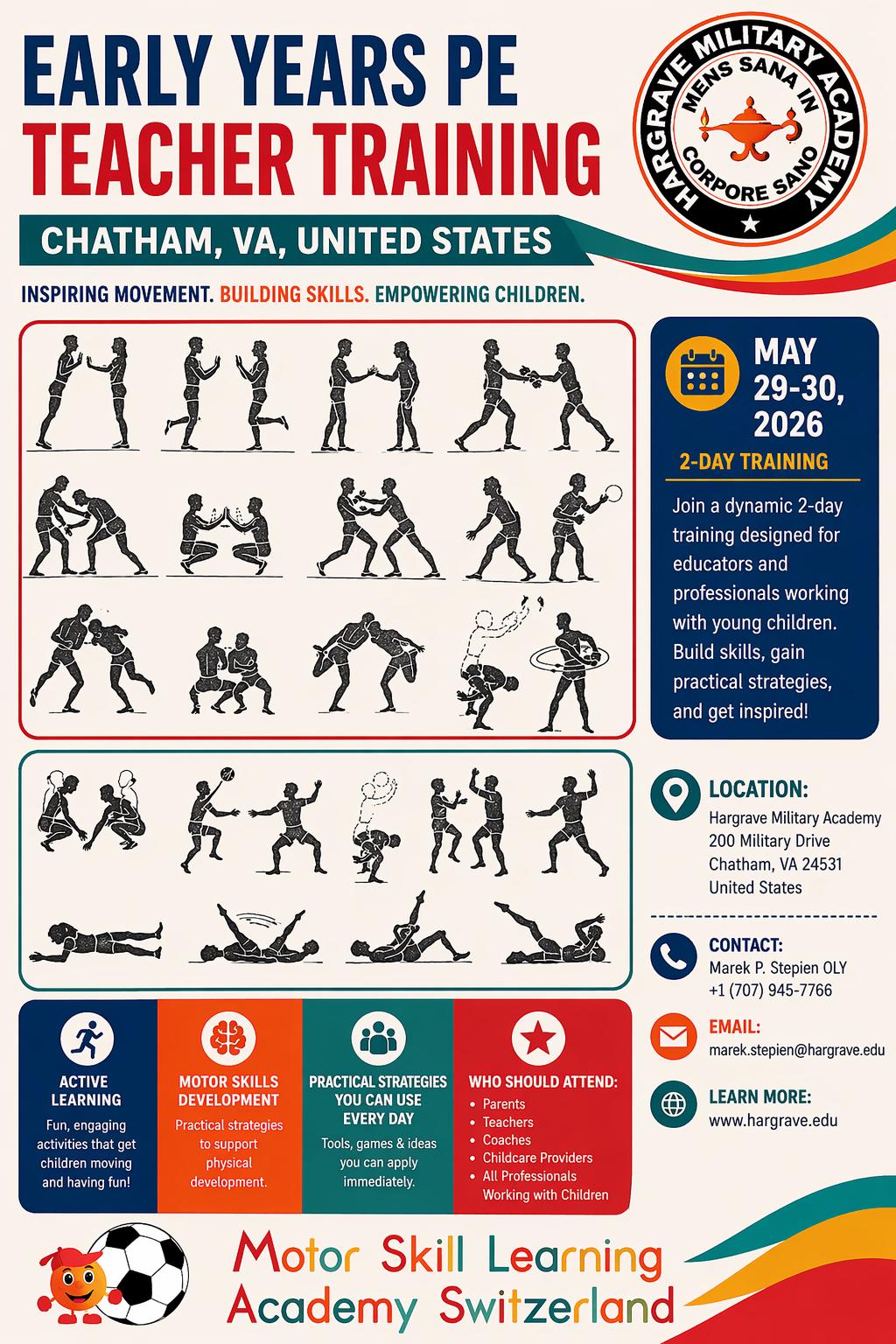
This issue is especially relevant in the context of the Hargrave Military Academy-hosted Motor Skill Learning Academy Switzerland programme. Hargrave Military Academy, located in Chatham, Virginia, United States, publicly lists its address as 200 Military Drive, Chatham, VA 24531. Meanwhile, Motor Skill Learning Academy Switzerland presents itself as a provider of PE curricula and teacher-certification programmes for children aged 3–7, highlighting engaging teaching methods and structured support for practitioners.
The purpose of this article is threefold. First, it reviews the scientific basis for the importance of early motor development and physical education. Second, it discusses the pedagogical role of teachers, parents, coaches, and other professionals in shaping children’s movement experiences. Third, it situates these findings within the practical relevance of a professional-development programme hosted at Hargrave Military Academy.
Motor Competence as a Developmental Foundation
Motor competence refers broadly to the effective performance of fundamental movement skills, including locomotor skills, balance, stability, and object-control actions. In educational terms, it is best understood not as narrow athletic proficiency, but as a developmental resource that helps children participate confidently in play, structured learning, and physical activity. Barnett et al. (2016), in a systematic review and meta-analysis, identified multiple correlates of gross motor competence in children and adolescents, reinforcing the idea that motor skill development is embedded in a wider developmental system.
More recent evidence has strengthened this picture. Bao et al. (2024), in a systematic review and meta-analysis, reported a small-to-moderate positive association between motor competence and executive functions in children and adolescents. Their conclusion suggests that motor competence may support higher-order cognitive processes, including working memory, inhibitory control, and cognitive flexibility. This is highly significant for educators because it places motor development within the domain of cognitive and school readiness, rather than treating it as separate from academic development.
Similarly, McDonough et al. (2020) found that physical-activity interventions improved children’s motor skill performance in most of the randomized controlled trials included in their review. Their findings indicate that motor skills are trainable and responsive to intervention, especially when programmes are deliberately designed and consistently delivered.
Physical Education as an Educational Intervention
One of the most important conclusions in the literature is that physical education can function as a developmental intervention when it is curriculum-based, purposeful, and age-appropriate. Lorås (2020), in a systematic review and meta-analysis, found a statistically significant improvement in motor competence following curriculum-based physical education compared with active control groups. This suggests that PE should not be viewed merely as recreation or energy release. Properly designed PE contributes measurably to children’s motor development.
Related evidence from García-Hermoso et al. (2020) indicates that quality-based PE interventions are associated with improvements in health-related physical fitness. This is educationally important because physical fitness, motor competence, and movement confidence interact over time. When children feel competent, they are more likely to participate; when they participate, they improve; and when they improve, they are more likely to remain engaged.
The broader educational case for movement is also supported by Educating the Student Body (Kohl & Cook, 2013), which concluded that physical activity and physical education are important to students’ health and can contribute positively to educational functioning. In this sense, movement should not be understood as competing with learning, but as supporting it.
The Role of Teachers in Early Physical Education
Teachers occupy a central position in children’s physical education. They do more than supervise activity; they organise learning, structure progression, manage inclusion, and create the motivational climate in which children either engage or withdraw. Effective early-years PE requires pedagogical judgement, knowledge of child development, sensitivity to individual differences, and the ability to create movement experiences that are enjoyable, challenging, and developmentally appropriate.
The public materials of Motor Skill Learning Academy Switzerland indicate that its programmes aim to support this very area by offering curricula and certification pathways intended to help adults teach PE “for optimal learning and fun” and maintain children’s engagement while developing motor skills. Although this does not in itself constitute scientific proof of effectiveness, it does suggest alignment with a major educational need identified in the literature: practitioner preparation.
From a pedagogical standpoint, the most effective teacher is one who understands that movement instruction is not only about physical output but also about attention, confidence, sequencing, emotional safety, and joy in learning.
The Role of Parents
Parents are the child’s first movement environment. They shape routines, opportunities, attitudes, and expectations around activity. This influence is not limited to transportation or permission; it includes modelling active behaviour, participating alongside children, encouraging experimentation, and creating an emotional climate in which movement is associated with pleasure rather than pressure.
Petersen et al. (2020), in a systematic review, found a positive association between parent and child physical activity. Likewise, Su et al. (2022), in a meta-analysis, concluded that parental influence is meaningfully related to child and adolescent physical activity. These findings suggest that the educational value of physical development cannot be confined to schools alone. When parents understand the importance of movement and know how to support it, they reinforce and extend the work of teachers and coaches.
For this reason, any serious model of early physical education should regard parents as educational partners rather than passive observers.
The Role of Coaches and Other Professionals
Coaches and other professionals working with children also exert a major influence on developmental outcomes. Their role is not simply to teach technique, but to shape motivation, self-belief, persistence, and emotional responses to challenge. In structured activity settings, children learn not only how to move, but how to cope, cooperate, and progress.
This has important implications for professional preparation. Adults working with children need knowledge of pedagogy, motor learning, developmental progression, and age-appropriate task design. Programmes that aim to train such adults can therefore be educationally valuable, particularly when they focus on practical implementation rather than abstract theory alone.
In the case of Motor Skill Learning Academy Switzerland, the official materials emphasise a structured teaching system, certification, and curricula for ages 3–7. Again, this should be interpreted carefully: the official description indicates a focus on practitioner support and early-childhood PE, but the scientific literature supports the broader educational principle rather than providing direct peer-reviewed evaluation of the organisation itself.
The Hargrave Military Academy Context
The fact that Hargrave Military Academy will host the Motor Skill Learning Academy Switzerland programme on its campus adds a meaningful institutional dimension to the discussion. Hargrave Military Academy publicly identifies its campus at 200 Military Drive, Chatham, VA 24531. In addition, the Motor Skill Learning Academy site currently references teacher trainings, including a May 29–30 United States entry, which aligns with the programme context described here.
From an educational perspective, this hosting arrangement represents a noteworthy opportunity. It brings a specialised early-years PE model into a school setting and creates access for teachers, parents, coaches, and professionals who wish to strengthen their practical skills in working with children through movement. The significance of such an event lies not merely in attendance or certification but in the possibility of improving the quality of adult guidance that children receive.
Discussion
Taken together, the literature suggests several important conclusions. First, motor competence is a significant developmental construct rather than a narrow sports-related variable. Second, high-quality physical education can improve motor competence and contribute to broader developmental outcomes. Third, adults who work with children require intentional preparation if they are to design effective movement experiences. Fourth, a whole-system approach involving schools, families, and professionals is more developmentally coherent than leaving physical development to chance.
Within this framework, the Hargrave-hosted programme can be understood as a practical example of professional development responding to a genuine educational need. If teachers, parents, and coaches become more competent in guiding children’s movement, the likely benefits extend well beyond the gymnasium. They include greater participation, stronger self-confidence, healthier behaviour patterns, and more positive experiences of learning through the body.
Conclusion
The scientific literature strongly supports the educational importance of early physical education and motor development. Curriculum-based PE improves motor competence (Lorås, 2020), motor competence is positively associated with executive functioning (Bao et al., 2024), and adult support from teachers, parents, and coaches plays a substantial role in shaping children’s opportunities to move, learn, and thrive.
Against this background, the Hargrave Military Academy-hosted Motor Skill Learning Academy Switzerland programme should be regarded as a timely and potentially valuable educational initiative. Hargrave Military Academy provides the school setting in Chatham, Virginia, while Motor Skill Learning Academy Switzerland offers an early-years PE model that publicly emphasises engaging curricula and coach certification for children aged 3–7.
The central educational message is clear: when adults are well prepared to teach through movement, they do more than improve physical skills. They help children become healthier, more confident, more capable, and better prepared to participate fully in learning and life.
References
Bao, R., Chen, P., Liu, C., Jiang, Y., and Zhao, Y. (2024). Associations between motor competence and executive functions in children and adolescents: a systematic review and meta-analysis. Sports Medicine.
Barnett, L. M., Lai, S. K., Veldman, S. L. C., Hardy, L. L., Cliff, D. P., Morgan, P. J., et al. (2016). Correlates of gross motor competence in children and adolescents: a systematic review and meta-analysis. Sports Medicine.
García-Hermoso, A., Alonso-Martínez, A. M., Ramírez-Vélez, R., Pérez-Sousa, M. Á., Ramírez-Campillo, R., and Izquierdo, M. (2020). Association of physical education with improvement of health-related physical fitness outcomes and fundamental motor skills among youths: a systematic review and meta-analysis. JAMA Pediatrics.
Kohl, H. W., III, and Cook, H. D. (Eds.). (2013). Educating the student body: taking physical activity and physical education to school. National Academies Press.
Lorås, H. (2020). The effects of physical education on motor competence in children and adolescents: a systematic review and meta-analysis. Sports.
McDonough, D. J., Pope, Z. C., Zeng, N., Lee, J. E., Gao, Z. (2020). Effects of physical activity on motor skill development in children: a systematic review and meta-analysis. Journal of Science and Medicine in Sport.
Motor Skill Learning Academy Switzerland. Official website and certification materials.
Petersen, T. L., Møller, L. B., Brønd, J. C., Jepsen, R., and Grøntved, A. (2020). Association between parent and child physical activity: a systematic review. International Journal of Behavioral Nutrition and Physical Activity.
Su, D. L. Y., Wang, L., Zhang, C., et al. (2022). Parental influence on child and adolescent physical activity: a meta-analysis. International Journal of Behavioral Nutrition and Physical Activity.